Stay in Japan. Permanently
Japan's new Employment for Skill Development (ESD) program gives you what TITP never could — a visa with no end date and a path to bring your family. Start preparing now.
Get Notified When ESD Opens
Be first in line — industry eligibility check, timeline, and application guidance.

Japan Isn't Doing You a Favor.
Japan Needs You
Japan's workforce is shrinking. By 2040, the country will be short millions of workers in healthcare, construction, manufacturing, and food service. The government didn't create ESD out of generosity — they created it because the economy depends on skilled workers like you choosing to stay. This time, the system is built around keeping you, not sending you home.
Your Pathway, Stage by Stage
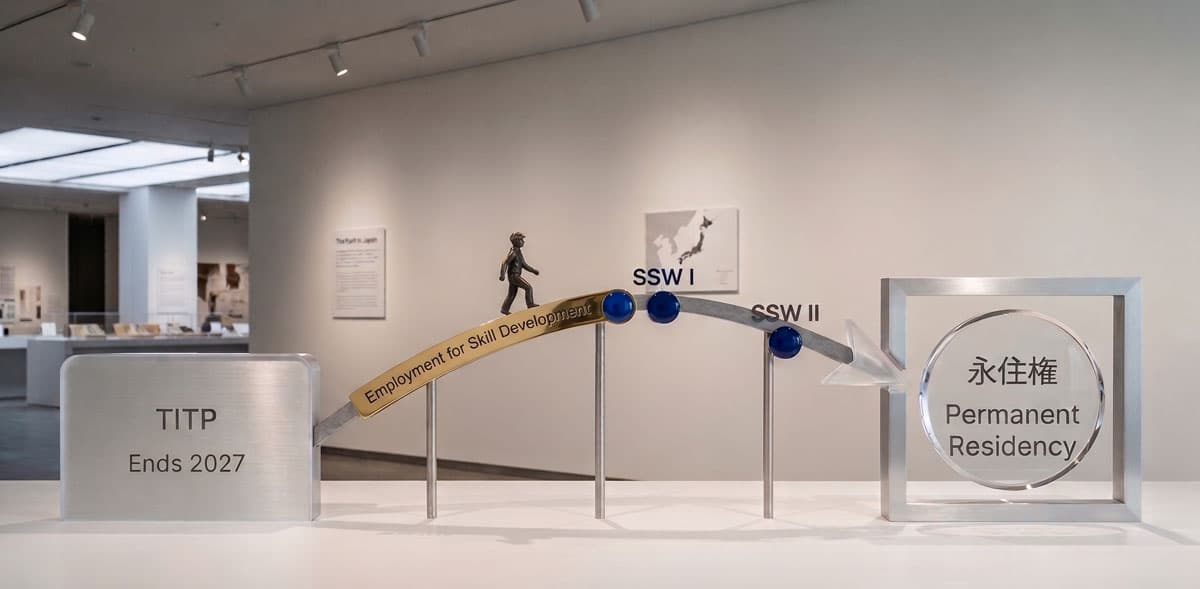
What Actually Changes
A side-by-side look at TITP vs. the new ESD framework.
16 Qualifying Industries
Organized across 7 official ESD industry groups. If your TITP field is on this list, you may qualify to transition directly into SSW I.
Agriculture & Natural Resources
Construction & Materials
Environment & Sustainability
Food & Hospitality
Healthcare & Facility Services
Manufacturing & Engineering
Transportation & Logistics
Your Japanese Level Is Your Visa Level
Each stage of the pathway requires a specific level of Japanese. Start now — the earlier you prepare, the smoother your transition.
Use the table below to find where you are today — and which study track gets you to the level you need.
Which Japanese Level Do You Need?
N4, N3, and N2 are the levels that matter for ESD and SSW. N5 and N1 are shown for context only.
| Study Level | N5 | N4 ESD | N3 SSW I | N2 SSW II | N1 |
|---|---|---|---|---|---|
| Beginner | → | ||||
| Foundation | → | ||||
| Intermediate | → | ||||
| Workplace Ready | → | ||||
| Advanced | → | ||||
| Professional | → | ||||
| Business Fluency | → |
Ready to Plan Your Path?
Frequently Asked Questions
Information on this page reflects publicly available government announcements as of May 2026. ESD program details are subject to change.